"Learning Time" Set — Teaching Clock and 24 Cards, 3 Difficulty Levels
SKU:
f5951

"Learning Time": from digits on a screen to hands on a dial
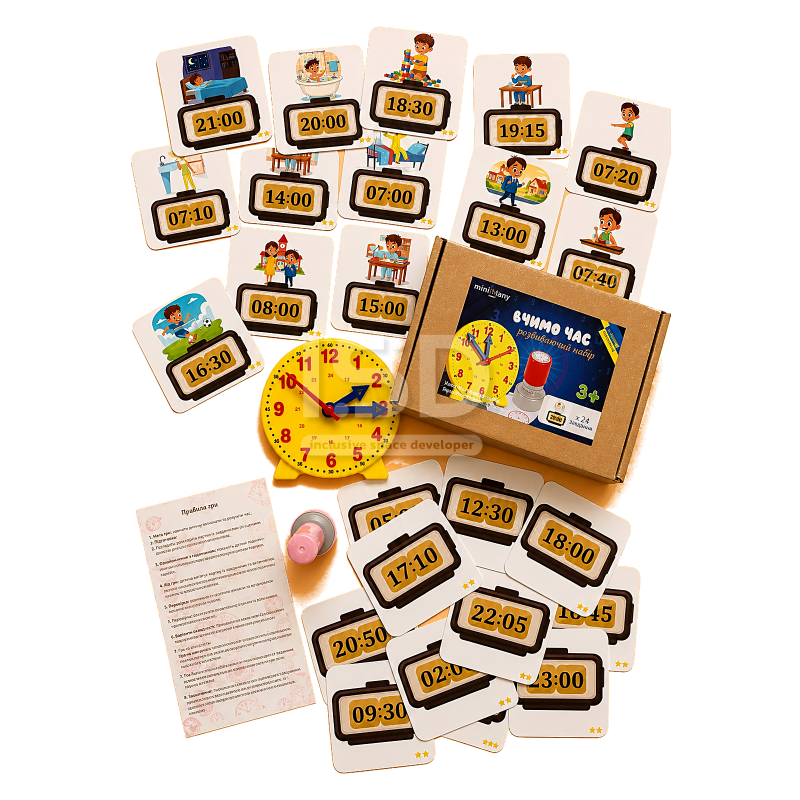
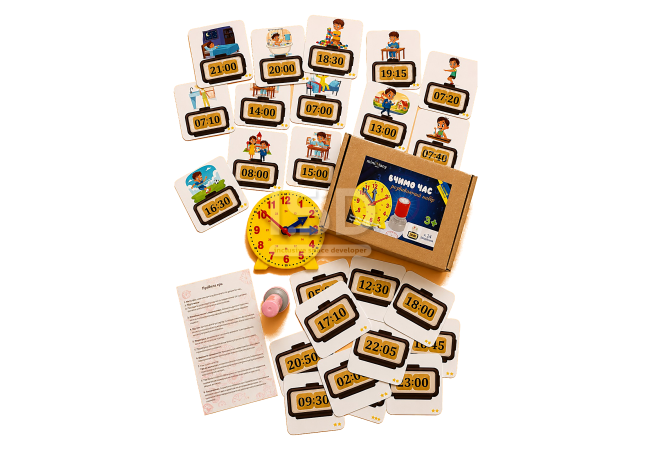
A teaching clock with movable hands, 24 task cards across three difficulty levels, a stamp and printed game rules. The child draws a card, reads the time and sets it on the clock.
Why it matters now. Children read 18:30 effortlessly — that format is everywhere. An analogue dial, however, is a puzzle. Yet the dial is what remains in the classroom, the doctor's office, the station and on a parent's wrist.
A clock showing both formats. The dial carries two numberings: large red 1–12 and small 13–24 with a minute scale. The child sees for themselves that 19:00 is seven in the evening — the 13:00-to-one-o'clock jump is solved by the dial's design rather than by explanation.
Three levels marked by stars. whole hours · halves and quarters · arbitrary minutes.
Half the cards describe the child's own day — waking, breakfast, school, lunch, football, bath, bedtime. Time becomes meaningful when tied to events, and these cards also build a visual daily schedule.
The box says 3+, which is a safety marking, not a methodological one. Whole hours are typically mastered around 5–6, halves and quarters at 6–7, arbitrary minutes from 7. At 3–4 only the routine cards are usable. The set lasts several years — but do not expect a three-year-old to set 22:05.
| General | |
| Material | Матеріал годинника Пластик Матеріал карток Картон Упаковка Крафт-коробка з кольоровою етикеткою |
| Compound | Навчальний годинник · картки із завданнями · печатка · правила гри |
Cards with cubes: the child checks their own workTwenty-five double-sided cards and fifty interlocki..
Acoustic Lotto – A Game for Developing Auditory PerceptionAcoustic Lotto is a unique educational too..
Cards with cubes: the child checks their own workTwenty-five double-sided cards and fifty interlocki..
Acoustic Lotto – A Game for Developing Auditory PerceptionAcoustic Lotto is a unique educational too..
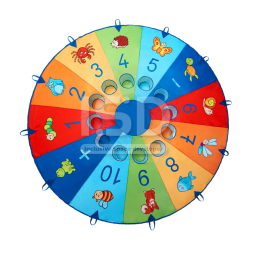
Interactive Play Circle with Pockets and NumbersDescription: This colorful fabric play circle is de..
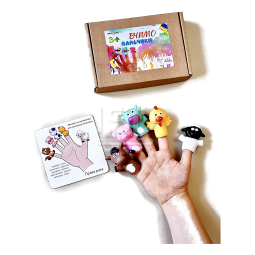
"Learning Fingers": a set where the child learns to control each finger separatelyFive rubber animal..
Cards with cubes: the child checks their own workTwenty-five double-sided cards and fifty interlocki..
Acoustic Lotto – A Game for Developing Auditory PerceptionAcoustic Lotto is a unique educational too..
Interactive Play Circle with Pockets and NumbersDescription: This colorful fabric play circle is de..
"Learning Fingers": a set where the child learns to control each finger separatelyFive rubber animal..